Idea Mobile
HOMEPAGE - http://10.4.42.15
I.P. ADDRESS - disabled
PORT - disabled
APN - mobile
Idea Internet
HOMEPAGE - http://www.google.co.in/m?client=ms-idea_apn-in&channel=DL
I.P. ADDRESS - disabled
PORT - disabled
APN - internet
Idea GPRS
HOMEPAGE - http://wap.ideafresh.com
I.P. ADDRESS - 10.4.42.15
PORT - 8080
APN - imis
Idea MMS
HOMEPAGE - http://10.4.42.21:8002
I.P. ADDRESS - 10.4.42.15
PORT - 8080
APN - mmsc
Airtel Live
HOMEPAGE - http://live.airtelworld.com/
I.P. ADDRESS - 100.1.200.99
PORT - 8080
APN - airtelfun.com
Mobile Office
HOMEPAGE - http://google.com
I.P. ADDRESS - 202.56.231.117
PORT - 8080
APN - airtelgprs.com
NOP
HOMEPAGE - http://live.airtelworld.com/
I.P. ADDRESS - 100.1.200.99
PORT - 8080
APN - airtelwap.com
Airtel MMS
HOMEPAGE - http://100.1.201.171:10021/mmsc
I.P. ADDRESS - 100.1.201.172
PORT - 8799
APN - airtelmms.com
BSNL net
HOMEPAGE - http://www.bsnl.co.in
I.P. ADDRESS - disabled
PORT - disabled
APN - bsnlnet
BSNL live
HOMEPAGE - http://bsnllive
I.P. ADDRESS - 10.220.67.131
PORT - 8080
APN - bsnllive
BSNL wap
HOMEPAGE - http://wap1.cellone.in
I.P. ADDRESS - 10.220.67.131
PORT - 8080
APN - bsnlwap
BSNL portal
HOMEPAGE - http://wap.cellone.in
I.P. ADDRESS - 10.220.67.131
PORT - 8080
APN - bsnlportal
BSNL MMS
HOMEPAGE - http://bsnlmmsc.in
I.P. ADDRESS - 10.220.67.131
PORT - 8080
APN - bsnlmms
Vodafone Live
HOMEPAGE - http://live.vodafone.in
I.P. ADDRESS - 10.10.1.100
PORT - 9401
APN - portalnmms
Vodafone MMS
HOMEPAGE - http://mms1.live.vodafone.in/mms
I.P. ADDRESS - 10.10.1.100
PORT - 9401
APN - portalnmms
****Authentification-Normal, Bearer – GPRS , Network Type- Ipv4, LT=90min, DNS-disabled, Login/Password-Blank
By- RAJESH KAMBOJ
I.T.(9432) JCDV
Friday, April 9, 2010


Thursday, April 8, 2010
EXTERNAL LINKS TO THE LAST POST
ANSWER TO QUESTION NO. 1
ANSWER TO QUESTION NO. 2
ANSWER TO QUESTION NO. 3
ANSWER TO QUESTION NO. 4
ANSWER TO QUESTION NO. 5.1
ANSWER TO QUESTION NO. 5.2 or CLICK HERE
-
by-
RAJESH KAMBOJ
I.T.(9432) @ JCDMCOE
ANSWER TO QUESTION NO. 2
ANSWER TO QUESTION NO. 3
ANSWER TO QUESTION NO. 4
ANSWER TO QUESTION NO. 5.1
ANSWER TO QUESTION NO. 5.2 or CLICK HERE
-
by-
RAJESH KAMBOJ
I.T.(9432) @ JCDMCOE
Wednesday, April 7, 2010
SOLUTION OF 1st SESSIONAL OF BIOTECHNOLGY
JAN NAYAK CHAUDHARY DEVILAL COLLEGE OF ENGINEERING
1st SESSIONAL
PAPER - BIOTECHNOLOGY (BT-101-E)
M.M. 20
TIME- 60 MIN
SOLUTION-
Q.1 Explain four differences between animal and plant cell ?
Ans.
1. In Plant Cell, Cell wall made up of cellulose present outer to the cell-membrane, while in Animal cell, cell wall is absent, only plasma membrane is present.
2. In plant cell, Plastids are present. In animal cell plastids are absent.
3.In Plant cell Lysosome are absent, in Animal Cell these are present.
4.Plant Cell is generally regular in shape while Animal cell is generally irregular in shape.

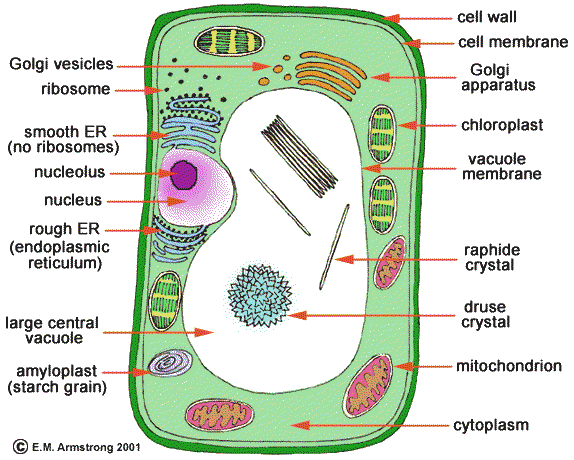
Q.2 Write a note on the structuree and functions of ENDOPLASMIC RETICULUM.
Ans. ENDOPLASMIC RETICULUM is a three-dimensional complicated and inter-connected system of membrane-lined channels that run through the cytoplasm.
ENDOPLASMIC RETICULUM of muscle cells is specialised and is called sacroplasmic retculum. The extent of ENDOPLASMIC RETICULUM varies from cell to cell.
They are quite extensive in metabolically active cells, are quite simpl;e in storage cells and absent in eggs, mature erythrocytes embryonic cells, resting cells prokaryotic cells etc.

Functions of ENDOPLASMIC RETICULUM-
1. They provide a large surface area inside the cell for various physiological activities.
2. It functions as cytoskeleton or intracellular and ultra stuctural skeletal frame work by providing mechanical support to colloidal cytoplasmic matrix.
3. ENDOPLASMIC RETICULUM connects two adjacent protoplasts through plasmodesmata.
4. ENDOPLASMIC RETICULUM acts as a means of quick intracellular transport.
Q.3. Explain Protein Structures (Primary, Secondary, Tertiary).
Ans. 1. Primary Structure- It consists of the sequence of amino acid residues joined through peptide bonds in the poly peptide of a protein. The o. of amino acid residues in a chain and the arrangement of amino acid are usually specific, as each poly-peptide is synthesised under instructions from a sistron of DNA through mRNA.The adjacent amino acids are held together by peptide bonds (-CO-NH-).

2. Secondary Structure- It refers to the manner of extention or helical coiling of poly-peptide chain which results mainly from hydrogen bonding between oxygen of carboxylic group of one amino acid residue and > NH group of the next fourth amino acid residue.
3. TERTIARY STRUCTURE- It refers to the folding and bending of teh polypeptide chain to form globular proteins induced by covalent disulphide bonds(-S-S-), hydrogen and salt bond , and hydrophobic / hydrophilic interactions.
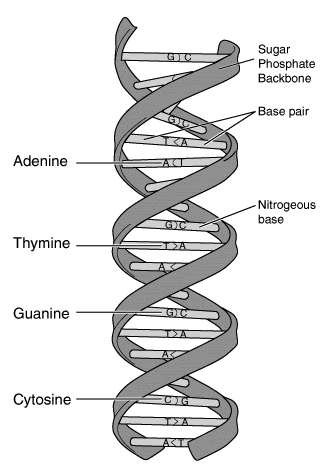
Q.4 Explain structure of DNA with its functions.
Ans.Structure of DNA
Functions of DNA-
1. DNA is the genetic material which carries all the hereditary information.
2. DNA has a unique property of replication or production of carbon copies. This is essential for transfer of genetic information from one cell to its daughters and from one generation to the next.
3. DNA occurs inside chromosomes. During meiosis ,crossing over gives rise to new combination of genes called Recombination.
4. Changes in sequence from Nitrogen bases due to addition, deletion or wrong replication give rise to mutations.
Q.5 Write any eight functions of lipids and characteristics of enzymes.
Ans. Functions of lipids-
1. They serve as food reserve in both plants and animals. There oxidation yields energy for growth.
2. They fuction as concentrated because as compared to carbohydrate, they yield more than twice as much energy per unit weight.
3. They function as a protective component of the cell walls of bacteria, plant leaves and skin of vertebrates.
4. In seeds and spores, they help in thermal insulation, protection from ultra-violet radiation and loss of water.
Characteristics of Enzymes-
1. All enzymes are proteins and share common properties.
2. They form colloidal solution and are of high molecular weight.
3. They catalyze every chemical reaction that occurs in the living system.
4. Enzymes do not altar the amount or nature of the product.
by-
RAJESH KAMBOJ,
IT(9432) @ JCDMCOE
Tuesday, April 6, 2010
DIFFERENCE BETWEEN PROKARYOTIC AND EUKARYOTIC CELL
View here the difference between two types of cell in detail.
just click here
 EUKARYOTIC CELL
 PROKARYOTIC CELL
just click here
EUKARYOTIC CELLPROKARYOTIC CELL
Subscribe to:
Posts (Atom)